| DE |
Learning from the Grassroots is an association based in Austria (ZVR 1703937164). It brings together people involved in grassroots initiatives who are working towards social change in the field of food sovereignty.
The Learning from the Grassroots association focuses on three key areas:
- Raising awareness of the impact of civil society initiatives
- Facilitating learning from innovative grassroots initiatives
- Documenting experiences and making them publicly available
Across many communities, people are already developing new ways of living and working together that are more sustainable, just, and resilient. Yet much of the knowledge generated through these experiences remains local and largely invisible in public debate.
Rather than promoting ready-made solutions, we focus on the experiences, questions, tensions, and learning processes that emerge from practice. We are interested in how change happens, what makes it difficult, what people learn along the way, and how their experiences might be meaningful to others.
Once a month, we hold conversations with people who are driving social change in the area of food sovereignty, which we publish as audio podcasts.
Our approach: Practice, reflection, and public dialogue
Learning from the Grassroots works at the intersection of three interconnected areas:
- Practice: Learning from people who are actively creating change in their communities.
- Reflection: Creating space to examine experiences, challenges, uncertainties, and lessons learned.
- Public dialogue: Documenting these experiences and making them accessible so that others can learn from them.
We see grassroots initiatives as important spaces of social learning and collective experimentation. They often emerge in response to problems that established institutions and conventional approaches have not adequately addressed. Their work can reveal alternative ways of organising, sharing resources, building relationships, and taking collective responsibility.
At the same time, we do not want to present grassroots practice as a succession of success stories. Initiatives encounter conflicts, limitations, setbacks, and difficult decisions. These experiences are an essential part of the learning process, yet they are rarely given the same attention as visible achievements.
We therefore aim to create a space in which people can speak openly about what they have experienced, what remains unresolved, and what they are still trying to understand.
Our approach is documentary in spirit: listening carefully, observing, asking questions, and reflecting together. We do not seek to impose standardized models or extract universal lessons from very different contexts. Instead, we want to understand how people respond to the specific conditions in which they find themselves, and how their actions may change those conditions.

The podcast: Our central learning format
The podcast is the central format of Learning from the Grassroots and our most important instrument for learning and reflection.
The audio-podcasts will be in German. English transcripts of the podcast conversations will be available for members to download.
Once a month, we hold moderated conversations with people who have initiated or are actively shaping processes of social change, particularly in the field of food sovereignty.
These are not conventional interview formats. They are community-informed, multi-voiced conversations that give practitioners the opportunity to describe their experiences in their own words. The focus is on the realities of their work: the challenges they face, the decisions they make, the tensions that arise, and the questions that remain open.
Podcast Team

Irene Wildenberg

Eva Pudill
The conversations are intended to go beyond presenting an initiative or explaining what it does. They explore the processes behind its practise: how people come together, how they deal with uncertainty, how they develop new approaches, and how their understanding changes through experience.
In this way, the podcast becomes a public space for collective reflection on civil society practice. It makes practical knowledge available beyond the communities in which it originates and encourages listeners to relate these experiences to their own work and circumstances.
The podcast also provides a foundation for our wider activities, including exchange between initiatives, community discussions, workshop formats, and the documentation of grassroots transformation.
Learning together as members
Membership offers an opportunity to become part of a respectful community of people who are not only discussing social change but actively working towards it.
Members gain access to moderated podcast conversations with practitioners, as well as additional bonus episodes – exclusively for members. Transcripts can be made available when needed. Members can also participate in online Q&A sessions, which take place one week before the recording of the podcast. In these online community sessions members can contribute their own questions and reflections. They will be recorded and made accessible afterwards.
Beyond these formats, membership is about exchanging experiences with others on an equal footing. Members are invited to bring their own questions, doubts, practical knowledge, and challenges into the conversation or the comment sections of the website.
The intention is not to provide definitive answers or prescribe a particular way of working. It is to create opportunities for mutual learning among people who may be working in different contexts but encounter comparable questions about community, collaboration, sustainability, and social change.
Who we bring together
Learning from the Grassroots is for people who are involved in, interested in, or want to learn from grassroots initiatives and civil society transformation.
This includes people working in areas such as:
- Food sovereignty and alternative food systems
- Ecological and community-oriented housing
- Community building and collective forms of organisation
- Civil society engagement and collective political action
- Sustainable, solidaristic, and resilient ways of living
We are particularly interested in initiatives that strengthen local communities and develop practical alternatives to existing social and economic arrangements.
Our community is not limited to people who already have extensive experience. People who are curious about grassroots organizing, seeking connections, or reflecting on their own engagement are also welcome.
What matters is curiosity, and a willingness to listen, share experiences, ask questions, and learn from others.
Our wider purpose
The association’s work extends beyond the podcast. Our purpose encompasses three interconnected areas.
Education: in the future, we aim to develop workshops that facilitate collaborative learning and create space for participants to develop their own ideas and approaches.
Networking: By connecting practitioners with one another, we aim to foster mutual support, build new relationships, and facilitate the exchange of practical knowledge.
Documentation: Over time, we aim to build an open archive of grassroots transformation. This involves making experiences, approaches, and insights accessible that might otherwise remain confined to individual projects and communities.
These three areas complement and reinforce one another. Documented experiences can be incorporated into workshop formats; these, in turn, can foster new connections; and the networks can generate further experiences worth reflecting on and sharing.
We want to understand how people shape change, overcome obstacles, resolve conflicts, and make decisions together.
Connection to the documentary film project
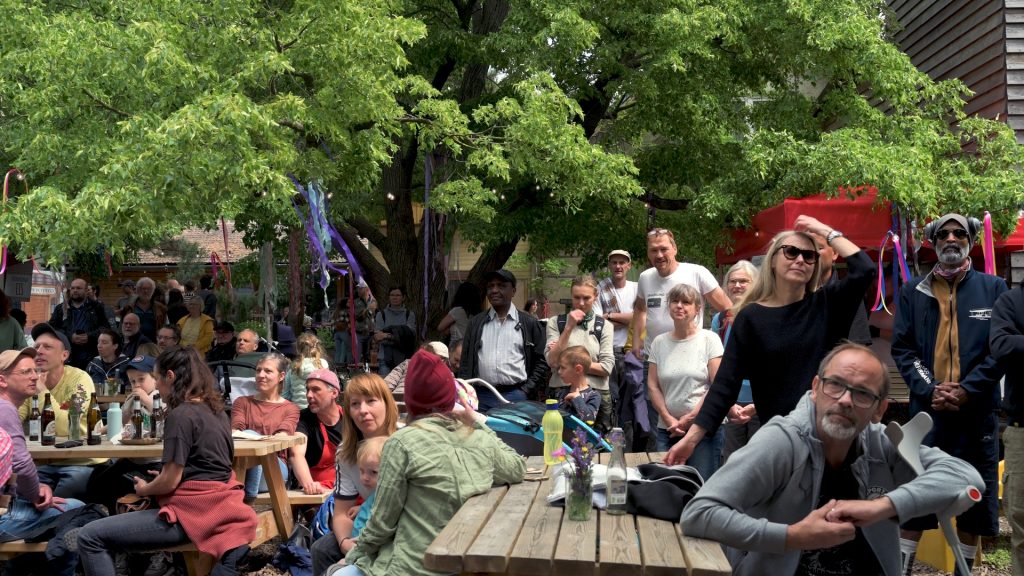
The Learning from the Grassroots Association grew out of documentary surrounding the film project Learning from the Grassroots: Land in Sicht. The film offered insights into how people organize themselves at the grassroots level, develop practical alternatives, and work together to address the challenges of collaboration.
Film and podcast are different formats, but they share a common interest: understanding social change from the perspective of the people who are actively shaping it.
The documentary perspective also shapes how we approach knowledge. We do not view practitioners merely as sources of information about their projects. Their experiences, reflections, and questions are valuable in their own right and can contribute to a more comprehensive understanding of how social change comes about.
Why grassroots experience matters
Many of the challenges our society is facing cannot be overcome by technical solutions alone. It is also about how people organize their lives, make decisions, share resources, build trust, and take on responsibility together.
Public debates often focus on successful models, while the uncertainties and learning processes that precede them receive little attention.
We want to create a space where people with hands-on experience can share their stories, reflect on the conditions under which they work and live, and share their insights with others.
A community of shared learning
Learning from the Grassroots is an ongoing process rather than a finished model. We are developing formats and relationships that allow knowledge from grassroots practice to circulate, encourage reflection, and reach beyond its situatedness.
We do not assume that every initiative can provide answers for others, or that experiences from different places can simply be transferred from one context to another. Instead, we believe that meaningful exchange begins by taking these differences seriously while remaining open to what others can teach us.
We believe that social change becomes possible when people learn from one another, reflect critically on their circumstances, and take collective action to shape their futures.
People, as beings ‚in a situation‘, find themselves rooted in temporal-spatial conditions which mark them and which they also mark. They will tend to reflect on their own ’situationality‘ to the extent, that they are challenged by it to act upon it. Human beings are because they are in a situation. And they will be more, the more they not only critically reflect upon their existence but critically act upon it. Reflection upon situationality is reflection about the very condition of existence. […] Only as this situation ceases to present itself as a dense, enveloping reality or a tormenting blind alley, and they can come to perceive it as an objective-problematic situation – only then can commitment exist.
Paolo Freire, Pedagogy of the Oppressed, p. 82